
Recurring Office Cleaning vs One-Time Commercial Clean: Which Does Your Las Vegas Office Actually Need?
TL;DR. Most occupied offices need a recurring office cleaning contract on a set schedule, not a one-time visit. The two are different products, scoped and priced differently. A one-time commercial clean solves a specific trigger event: move-in, move-out, post-construction, post-event, or post-incident. The decision comes down to whether you’re replacing a vendor relationship or handling a one-off problem. For most offices with full-time occupancy, a recurring contract is the baseline, and one-time cleans layer on top when trigger events call for them.
When an office manager starts shopping for commercial cleaning, the instinct is usually to compare recurring service against one-time options and ask: which one is better? That’s the wrong question. Recurring janitorial and one-time commercial cleans aren’t two intensities of the same service. They’re two entirely different products with different scopes, different pricing models, and different jobs to do. Getting clear on which one you actually need saves you from signing the wrong contract or, more commonly, from solving a vendor-relationship problem with a project purchase that won’t hold.
Contents
- 1 The real question isn’t recurring vs one-time
- 2 What recurring office cleaning actually means
- 3 What a one-time commercial clean actually means
- 4 How to tell which one your office needs
- 5 When both are the right answer
- 6 Questions to ask before signing either kind of contract
- 7 Why most offices end up on recurring, and what eco-certified service adds
The real question isn’t recurring vs one-time
Are you replacing an ongoing vendor relationship, or are you solving a one-off problem?
If there’s no cleaning vendor on contract today and your office has people in it five days a week, you need a recurring contract. That’s the baseline for any occupied commercial space. A one-time visit will leave things cleaner than they were, but it won’t maintain that state. By next week, you’re back where you started.
If you have a recurring contract and your renovation just wrapped up, you have a one-time problem. Construction debris, drywall dust, and surface residue aren’t what nightly janitorial was designed to handle. That calls for a one-time commercial clean on top of your contract, not instead of it.
Most occupied offices need a recurring contract as the foundation. One-time cleans handle the events that recurring service doesn’t cover.
What recurring office cleaning actually means
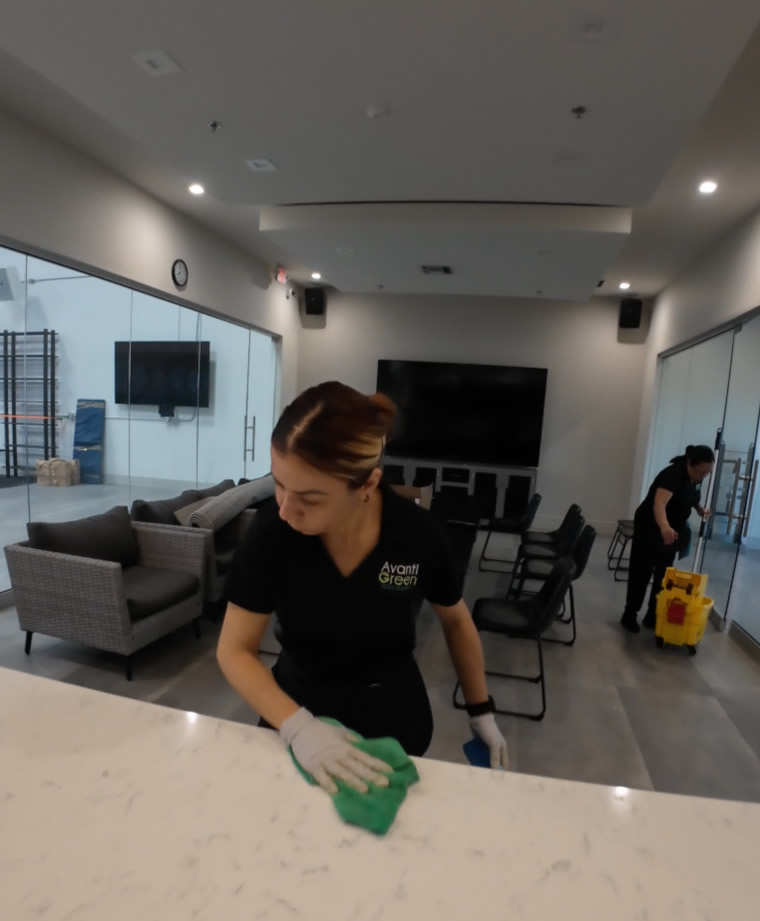
Recurring office cleaning isn’t a series of repeat appointments you book one at a time. It’s a janitorial service contract on a set schedule: nightly, five times a week, three times a week, or weekly, depending on your traffic and facility type.
A real recurring contract comes with several things a one-time visit won’t include. First, a documented scope of work that spells out exactly what gets cleaned at each visit: which surfaces, which frequencies, which tasks are in and which are out. Second, a certificate of insurance on file with your building, which most commercial landlords require before any vendor gets after-hours access. Third, monthly invoicing against a fixed scope rather than variable project quotes. And fourth, a named account manager who owns the relationship, the person you call when something was missed or a task needs to change.
That last piece matters more than most buyers expect. Recurring crews learn the space over time. They know the high-traffic hallways, the bathroom that needs extra attention on Mondays, the conference room that gets wrecked on event nights. The third month of a well-run contract typically looks different from the first visit, not because the crew changed, but because they have context.
On the budget side, recurring service lands as a predictable operating expense. It lives in your facilities or office-ops budget line, not as a project cost you have to justify to finance on a one-off basis.
What a one-time commercial clean actually means
A one-time commercial clean is a single project-priced visit scoped to a specific trigger event. It’s not a sample of what a recurring vendor would do nightly. The scope, the crew size, and the depth of work are different.
The trigger events that typically justify a one-time commercial clean:
- Pre-occupancy move-in: when a new tenant wants the space cleaned before furniture goes in and employees show up
- End-of-lease move-out: cleaning to satisfy the lease return condition or deposit recovery requirements
- Post-construction or post-renovation: debris removal, surface wipe-downs, and detail work after contractors have been in the space
- Post-event venue reset: getting a conference room, lobby, or multi-use space back to baseline after a large event
- Pre-inspection prep: cleaning before a health inspection, landlord walkthrough, or client site visit
- Post-incident remediation: response to an illness outbreak, water event, or accident that left contamination beyond what routine maintenance covers
One-time cleans are priced as projects: flat-rate or square-foot, quoted after a walkthrough rather than from a recurring scope template. The quote will look different from a monthly janitorial proposal because the work is different.
“One-time” doesn’t mean “lighter.” These jobs are often more intensive than any single recurring visit, because they include scope that a nightly contract intentionally excludes by design.
How to tell which one your office needs
If your office has people working in it five days a week and there’s no recurring vendor on contract today, you’re shopping for a recurring contract.
If there is a recurring contract in place and something specific just happened (a renovation wrapped up, a big event left the space trashed, the previous tenant left behind a mess), that’s a trigger event calling for a one-time clean on top of the contract, not a reason to rethink your ongoing service.
A few facility-type signals push toward recurring, even if you were considering starting with a one-time:
- Client-facing lobbies: these spaces need to be reliably clean on a schedule, not cleaned when they look dirty
- Shared restrooms: frequency matters more than intensity; a deep clean last month doesn’t help today
- Kitchens and break rooms: high-touch, high-use, and a consistent source of odor and contamination if left to accumulate
- Medical and dental practices: infection control isn’t optional; it requires a schedule, a protocol, and documented compliance
- Any space where customer experience or employee health is directly tied to cleanliness: that’s a recurring-contract problem, not a one-time-clean problem
Recurring service and one-time cleans land in different budget buckets. Recurring service is an operating expense, a predictable monthly line item that the facilities manager or office ops team owns. A one-time clean tends to land as a project cost, discretionary spend that needs a different approval path. For offices where those budget buckets have different owners or different approval thresholds, the framing often decides who signs off.
Staff size and traffic also matter. Even a small office with five-day occupancy benefits from a two or three times per week cleaning rhythm. High-traffic lobbies and shared-tenant buildings often need day porter coverage on top of nightly janitorial: someone present during business hours to maintain restrooms, restock supplies, and handle spills as they happen, rather than waiting for the overnight crew.
When both are the right answer
The recurring-vs-one-time framing is often a false binary. Most offices eventually end up running both, because the two products complement each other rather than replace one another.
The most common pattern is a one-time deep clean to reset the baseline, then a recurring contract from that point forward. New tenants do this. Offices switching vendors do this. Post-renovation moves do this. Start the recurring contract from a clean baseline, not spending the first several weeks of nightly service chasing the mess left behind by the previous occupant or contractor.
The inverse pattern shows up in established accounts. A recurring janitorial contract handles the daily and weekly maintenance, but once or twice a year, the same vendor comes back for a deeper pass: carpet extraction, hard-floor refinishing, interior window cleaning. These tasks aren’t on the nightly scope by design. They’re too time-intensive and equipment-heavy to run on a regular cadence. They belong as scheduled add-ons.
Experienced facilities buyers think in terms of a baseline plus add-ons, not “should I pick recurring or one-time.” The combination is the actual product.
Running both through the same vendor simplifies things considerably. One certificate of insurance, one after-hours access protocol, one escalation path when something goes wrong. Coordinating a separate one-time vendor into a space that already has a recurring crew adds scope confusion and access complications that most office managers don’t need.
Questions to ask before signing either kind of contract
These questions apply before you sign anything, whether you’re evaluating a recurring contract or a one-time project quote.
What’s on the scope of work, line by line? A vague “general cleaning” quote is not a scope. Ask for specifics: restroom tasks (including which surfaces and at what frequency), trash and liner replacement, vacuuming, hard-floor care, high-touch disinfection, kitchenette tasks, and glass. If a vendor won’t document what’s included, that’s your answer about what will actually get done.
What’s the insurance situation? Get the certificate of insurance before signing. Confirm the coverage limits are appropriate for your facility, understand the workflow for getting the COI on file with your building’s property manager, and ask about after-hours access protocol. Ask whether the crew is W-2 employees or 1099 subcontractors, because the answer affects liability and consistency.
What products are they using, and are those products third-party certified? This matters more than a vendor’s marketing language. A cleaner can describe their service as “eco-friendly,” “non-toxic,” or “natural” without any independent verification. Those words aren’t regulated. Third-party certification, like Green Seal’s service certification for commercial cleaning organizations, requires documented verification of what’s being used, how it’s diluted, and what surfaces it’s compatible with. Ask whether the vendor can provide a safety data sheet list on request. For a clear breakdown of what those eco-labels actually mean, the difference between eco-friendly, non-toxic, and natural cleaning labels is worth reading before your next vendor conversation.
Who’s accountable when something goes wrong? Ask for the account manager structure: who do you call if a clean is missed, if a task was skipped, or if a crew member caused damage? Get the escalation path in writing, and read the termination clause carefully before you sign.
One-time quotes deserve the same vetting rigor as a recurring contract. A project-priced visit from an uninsured crew carries more risk than a recurring contract gone wrong, because there’s no ongoing relationship to lean on if something is damaged or a claim needs to be filed.
Why most offices end up on recurring, and what eco-certified service adds
Most occupied offices end up on a recurring contract because that’s what maintaining a commercial space actually requires. A one-time clean solves a moment; a recurring contract maintains a standard.
The indoor-air-quality case for consistent recurring service is worth understanding. The EPA’s guidance on indoor air quality in offices and other large buildings identifies dust, allergens, and surface contamination as persistent factors that accumulate in occupied commercial spaces. Consistent cleaning on a schedule, not ad hoc, keeps that accumulation low. In a residential setting, you might clean when it looks dirty. In a commercial setting, your employees are in that space 40 or more hours a week, often with no control over the ventilation or what their coworkers bring in. The exposure compounds across the workweek in a way it doesn’t at home. Recurring cleaning on a set cadence is what keeps it in check.
Avanti Green offers Green Seal certified recurring janitorial service in Las Vegas and Henderson. If you’re ready to see what a properly scoped recurring contract looks like for your facility, request a walkthrough and scope-of-work quote.