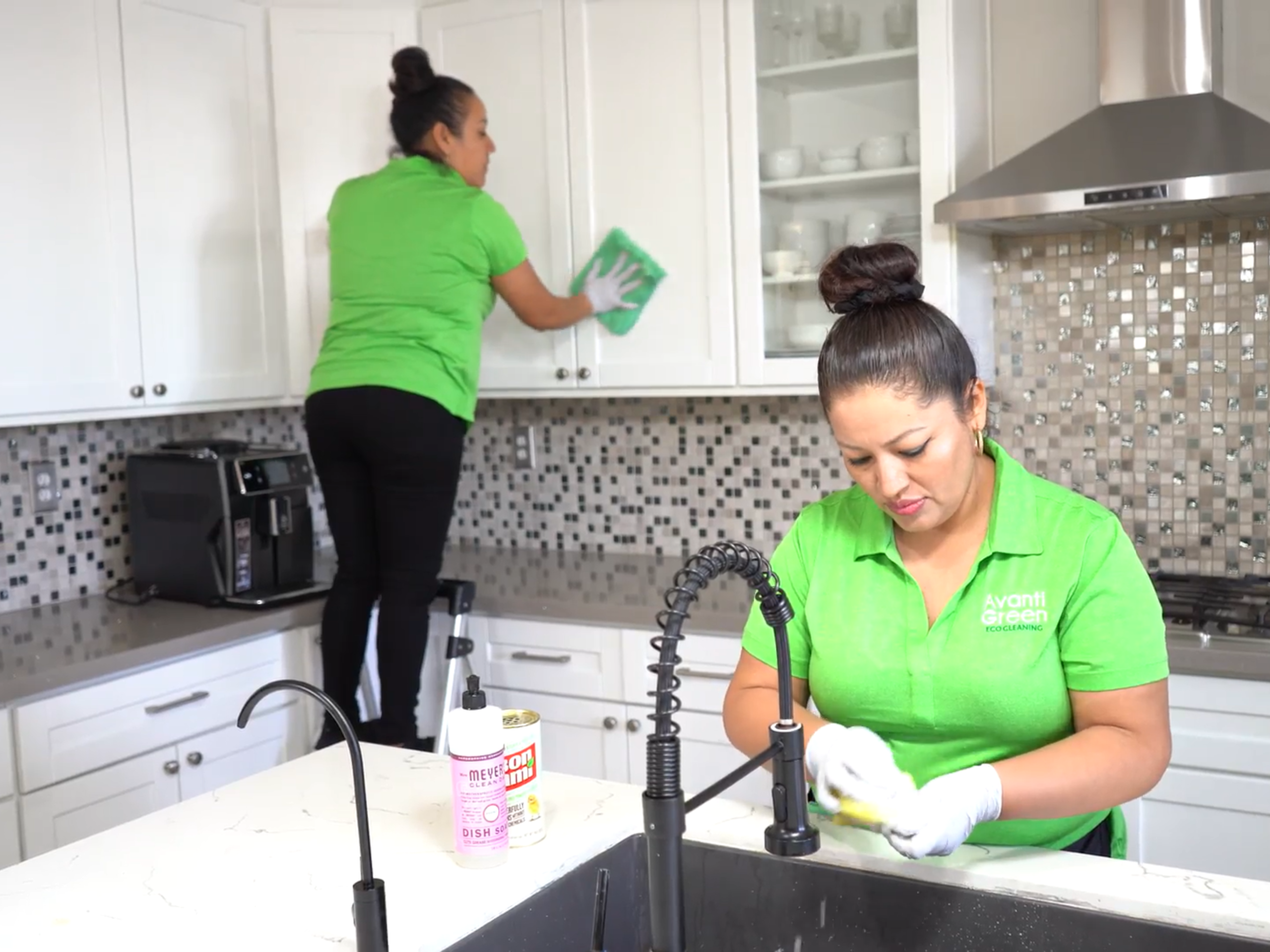
Deep Clean vs Recurring Clean: What’s the Difference and When Do You Need Each?
Deep cleaning is a one-time intensive reset that addresses baseboards, scale, vents, behind appliances, and other neglected zones. Recurring cleaning is the scheduled weekly, biweekly, or monthly service that maintains the reset. Most cleaning companies require a deep clean on visit one, then transition to a recurring cadence. The right choice usually isn’t either-or — it’s both, in sequence.
Spend ten minutes on r/housekeeping and you’ll see the same question: “I called for a regular cleaning and they quoted a deep clean instead — am I getting upsold?” Fair question. The honest answer takes more than a sentence, which is why most cleaning-company blogs gloss over it. Here’s the longer version: what each service covers, why most companies start with a deep clean, how to tell which you really need, and what changes when the products are Green Seal Certified.
Contents
- 1 What Is Recurring Cleaning?
- 2 What Is a Deep Clean?
- 3 Why Most Cleaning Services Require a Deep Clean First
- 4 Do You Actually Need a Deep Clean? A Decision Tree by Household State
- 5 How Often Should You Schedule Recurring Cleaning After the Deep Clean?
- 6 What’s Different When the Cleaning Is Eco-Certified?
- 7 Las Vegas-Specific Deep Clean Triggers
- 8 Cost & Cadence — Is Recurring Actually Cheaper Long-Term?
- 9 Frequently Asked Questions
- 10 Conclusion
What Is Recurring Cleaning?
Recurring cleaning — also called maintenance, regular, or standard cleaning — is the scheduled, ongoing service designed to prevent buildup rather than reverse it. A typical visit covers dusting reachable surfaces, vacuuming and mopping floors, sanitizing kitchen and bathroom high-touch areas, wiping mirrors, emptying trash, and light tidying.
Cadence — the recurrence interval — is what makes recurring service work:
- Monthly — low-traffic households, no kids or pets, owner is fastidious between visits.
- Biweekly — the typical fit for a working family with kids and pets.
- Weekly — allergy-sensitive households, frequent hosts, or multi-pet homes shedding year-round.
For Avanti’s recurring home cleaning programs, the same crew comes back each visit. That matters more than it sounds like it should — a team that knows your house already knows where your dog naps and which bathroom the kids use. Consistency is part of why recurring service produces better results over time than rotating one-offs.
What Is a Deep Clean?
A deep clean is the longer, more intensive one-time service that includes everything in a recurring visit plus hard-to-reach and habitually neglected zones. The standard scope on our Las Vegas deep cleaning service — and across most reputable cleaning companies — covers baseboards, inside the oven and refrigerator (on request), grout and tile scrubbing, hard-water scale removal on shower glass and fixtures, vents, window sills and tracks, behind and under furniture, and polishing of surfaces and appliances.
Just as important: what a deep clean doesn’t include by default. Top cleaning blogs rarely spell this out, which is how customer expectations get bruised. A standard deep clean typically does NOT cover:
- Carpet shampooing or extraction (separate service)
- Exterior windows beyond ground-floor reachable panes
- Organizing or decluttering (we clean what’s visible; we don’t sort)
- Specialty hazmat work like mold remediation or biohazard cleanup
- Move-out condition for an empty home (that’s a move-in / move-out clean, a deep-clean variant priced separately)
- Drywall dust and construction debris (a post-construction clean, also separate)
When you compare deep cleaning vs regular cleaning, the difference isn’t only “more time and more zones” — it’s a different mental model. Deep cleaning is a reset. Recurring is the pattern that keeps the reset from eroding.
Why Most Cleaning Services Require a Deep Clean First
This is the part the top cleaning-company blogs skip, even though it’s the question every first-time client actually has. Most professional companies — including Avanti — book the first visit as a deep clean before transitioning to a weekly, biweekly, or monthly recurring schedule.
The reason is mechanical, not commercial. Recurring service is designed to prevent buildup, not reverse it. A two-hour standard visit walking into a year of ignored baseboards, oven scale, soap-film grout shadow, and HVAC dust is set up to fail. The crew can hit every line item on the checklist and the home will still look like it needs cleaning afterward — because the buildup is underneath the recurring scope, not on top of it.
A deep clean clears the decks. From there, a biweekly or weekly recurring visit can actually maintain the result, because the team is keeping a baseline rather than chasing a backlog.
That said, the upsell skepticism is fair. Some homes genuinely don’t need it. If your house was professionally cleaned in the last 60 to 90 days, or it’s a low-traffic owner-occupied home where the previous owner kept up with maintenance, a first recurring visit may be enough to start. The next section is the decision tree to figure out which camp you’re in.
Do You Actually Need a Deep Clean? A Decision Tree by Household State
Most articles on this topic organize by life event (“you’re moving,” “spring cleaning”). That’s the wrong axis. The question isn’t what’s happening in your life — it’s what state your house is currently in. Five common household states, and what each one usually warrants:
1. Recently professionally cleaned (last 60-90 days). A first recurring visit likely suffices. The baseline is already there. Tell the company about the recent service so they can scope accordingly.
2. DIY-only for a year or more, no service history. Deep clean recommended. Even a meticulous DIY routine misses what a service-level deep clean covers — vents, baseboards, inside ovens, behind appliances, scale on glass.
3. Just-completed renovation. This is a post-construction clean, not a standard deep clean. Drywall dust gets into HVAC systems and behind every surface; it requires specialized PPE and equipment.
4. Move-in or move-out. This is a move-in / move-out clean — a deep-clean variant scoped to an empty home with deposit-or-inspection criteria. Same intensity, different checklist.
5. Daily-use family home with kids and pets, never had a professional service. Deep clean strongly recommended. Allergens, pet dander, baseboard scuff, vent dust, and grout shadow add up fast in this profile, and a deep clean is the only way to start a recurring program from a real baseline. (For seasonal triggers, our seasonal deep-clean reset guide walks through the spring case in detail.)
If none of these match cleanly, ask the company for a walkthrough. A reputable team will tell you when a deep clean isn’t warranted.
How Often Should You Schedule Recurring Cleaning After the Deep Clean?
Once the reset is done, the next question is cadence. The framework above applies — monthly for low-traffic, biweekly for families with kids and pets, weekly for allergy-sensitive or hosting-heavy households.
For most Henderson and Summerlin parents we work with, biweekly is the sweet spot. It catches dust before it accumulates noticeably and stretches the deep-clean reset across most of the year without re-triggering it.
If you’re between two cadences, start at the higher frequency for the first couple of months and step down once you see how the house holds up — easier to spread visits out than to fight a backlog.
What’s Different When the Cleaning Is Eco-Certified?
Same coverage, different chemistry. A Green Seal Certified deep clean hits the same line items as a conventional one — baseboards, scale, vents, ovens, grout. What changes is the product palette and what’s left in your air after the team leaves.
Green Seal Certified is a third-party certification from Green Seal Inc. that audits cleaning service providers and individual products against rigorous health, environmental, and performance standards (see Green Seal Standards for general-purpose, bathroom, glass, carpet, and odor-control criteria). It’s not a marketing label — it’s a certification with measurable criteria.
The chemistry difference shows up most clearly after a deep clean, when many surfaces are treated at once. Conventional products can release volatile organic compounds (VOCs) that off-gas into your indoor air. Per the EPA’s guidance on VOCs and indoor air quality, indoor concentrations of some VOCs can be several times higher than outdoor levels and persist for hours after use. The EPA Safer Choice program identifies products meeting stricter human-health criteria — the kind a Green Seal Certified service uses on your shower glass and kitchen counters.
The fair counter-objection: eco-friendly products can’t handle deep-clean buildup. In practice, that’s outdated. Enzymatic cleaners break down protein and grease at the molecular level. Microfiber lifts particulate that conventional flat cloths just push around. Steam handles a wide range of grout and tile work without any chemistry at all. The narrow exceptions — severe mold, the most aggressive mineral-scale cases — usually warrant specialty service either way.
Las Vegas-Specific Deep Clean Triggers
National cleaning blogs miss what Vegas residents already know: the desert is hostile to clean homes. Three Vegas-specific drivers accelerate buildup:
Hard-water scale. Valley tap water is among the hardest in the country. Calcium and magnesium deposits show up first on shower glass, faucets, and fixtures. Recurring service prevents new deposits from forming, but established scale needs a deep-clean reset before recurring can keep up. (We cover removing hard-water scale on shower glass and windows separately.)
Monsoon dust events and haboobs. From mid-June through September, the National Weather Service Las Vegas Forecast Office tracks monsoon-season dust storms that deposit fine particulates into homes through doors, windows, and HVAC intake. After a single haboob, surfaces that looked clean yesterday are silted overnight. A late-summer or early-fall deep clean is warranted here in a way it isn’t in non-desert climates.
Year-round HVAC load. Vegas homes run cooling roughly nine months a year. The system is constantly pulling fine dust through filters and circulating it across surfaces. Vents, returns, and the tops of door trim collect particulate that recurring cleaning catches at the surface but can’t reach inside the system itself.
Cost & Cadence — Is Recurring Actually Cheaper Long-Term?
Yes, in almost every realistic scenario. Compare two common patterns over a year:
Pattern A: One deep clean to start, then biweekly recurring service for the rest of the year (about 25 visits total — one deep, 24 recurring).
Pattern B: Standalone quarterly deep cleans, no recurring service in between (4 visits total, all priced as deep cleans).
Pattern A typically costs less per year than Pattern B, even though it includes more total visits. Recurring visits are priced lower than deep cleans because they’re shorter and don’t repeat the reset work. More importantly, Pattern A keeps your home at a higher visible baseline year-round — recurring visits maintain the deep-clean result, so the house doesn’t drift back toward “needs a deep clean again” between visits. Pattern B saves no real money and lets buildup re-establish between each quarterly reset.
For actual dollar figures on your home, our team can scope both patterns during a walkthrough — pricing depends on square footage, bathroom count, pets, and add-ons, which is why we don’t post flat numbers. So is a deep clean worth it? Yes, if your home meets the conditions in the decision tree above. The point of the upfront deep clean isn’t the visit itself — it’s setting recurring service up to actually deliver the result you’re paying for.
Frequently Asked Questions
Can I refuse the first-visit deep clean and just start with recurring?
Sometimes — and a reputable company will tell you when. If your home was professionally cleaned in the last 60 to 90 days, a first recurring visit can usually do the job. Otherwise, expect a deep-clean scope, and ask the team to walk you through the specific reasons. A clear answer is the difference between a service and an upsell.
Is a deep clean worth it?
For homes that haven’t had a recent professional clean, yes — the deep clean isn’t a luxury, it’s the prerequisite that makes recurring service actually work. For homes with a strong baseline already, it’s negotiable.
Will eco-friendly products really get my baseboards and shower scale clean?
For routine deep-clean buildup, yes. Enzymatic cleaners, microfiber, and steam handle most of it. Narrow exceptions (severe mold, long-set mineral scale) warrant specialty service either way.
How often should I deep clean if I’m already on a recurring schedule?
Even households on consistent biweekly or weekly service benefit from an annual deep clean to reach what recurring scope doesn’t — vents, behind appliances, deeper baseboards, seasonal scale. In Vegas, scheduling that reset for late summer or early fall — after monsoon season — delivers the most visible result.
Conclusion
Deep cleaning resets a home; recurring cleaning maintains the reset. The question isn’t usually which one — it’s the order, and the cadence after. For most Henderson and Summerlin households, that means a deep clean to start and biweekly recurring from there.
If you’d rather not guess, request a no-obligation walkthrough. Avanti’s Green Seal Certified team can scope a Las Vegas deep clean or start you on a recurring home cleaning program based on what your home is actually showing — not what’s easier to upsell.